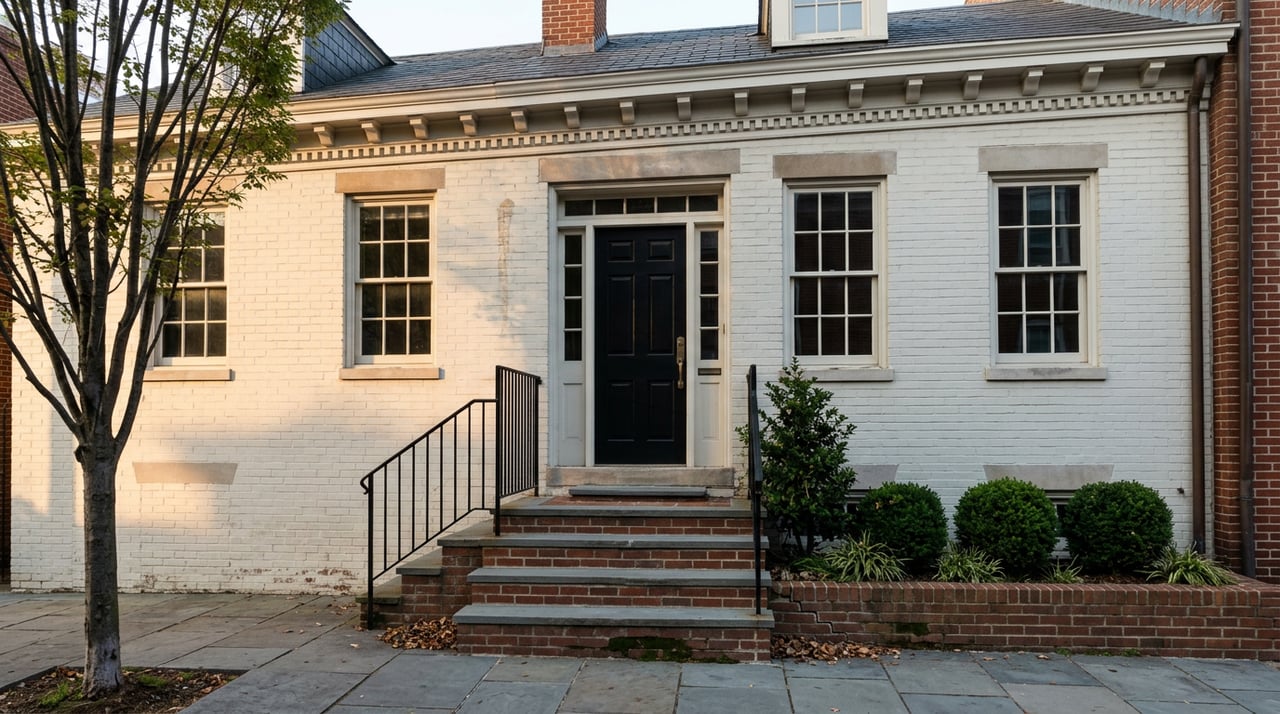
Most guides to renovating in Alexandria's historic districts treat the rules like a fixed rulebook. Learn the categories, get your Certificate of Appropriateness, done. That's been true for the better part of 33 years. That familiar process may soon look different.
The Zebra reported that Alexandria opened public comment on the first major proposed rewrite of its historic district design guidelines since 1993, and that the comment period closed September 2, 2026. If you own a home in Old Town or Parker-Gray and you're weighing a renovation before a sale, or you're a buyer eyeing one of those blue-shuttered rowhouses on Prince Street, the timing of your application may matter alongside the work you propose.
A Proposed Update to a 33-Year-Old Rulebook
The design guidelines governing the Old and Historic Alexandria District (OHAD) and the Parker-Gray Historic District were written in 1993, before EV chargers, security cameras, or small-cell wireless equipment existed as categories anyone needed to regulate. The Zebra's August 20 report describes how the city's Board of Architectural Review Design Guidelines Committee, formed in 2019, has spent several years working toward a replacement. Draft chapters went up for review on August 5, 2026. A community meeting followed on August 19 at the Nannie J. Lee Recreation Center on Jefferson Street, where preservation staff walked residents through 11 chapters of proposed changes. Public comment was open through September 2.
Planners have been clear this isn't a wholesale rewrite of preservation policy. It's a modernization of an outdated system, with a searchable, ADA-accessible format replacing what's currently a document better suited to a filing cabinet than a phone. But modernization isn't neutral. Some of what's changing loosens the path for certain projects. Some of it tightens the path for others, and it tightens unevenly across the two districts.
What's Actually on the Table
The chapters under review cover:
- Electric vehicle charging stations, including a path to administrative approval for some residential installations
- HVAC equipment and mechanical systems
- Exterior lighting and security features
- Small-cell wireless facilities mounted on buildings
- Porches, decks, and balconies
- Accessory structures and utility meters in Parker-Gray specifically
That last category is where the update stops being cosmetic. Right now, Parker-Gray's rules run on a different track than Old Town's. The draft moves Parker-Gray toward Old Town's standard rather than the reverse. Sheds and accessory structures up to 65 square feet and 8 feet tall would newly require administrative review in Parker-Gray, matching the Old Town threshold. New or relocated utility meters there would need staff approval for the first time. And existing exemptions for some non-front elevations in Parker-Gray would end, meaning work you could currently do without a second thought, on the side or back of a Parker-Gray property, moves into the review process.
Preservation staff have also floated the idea that the level of review itself could start varying by a building's architectural age, which is a meaningful departure from a system that has mostly asked "is it visible from the street" rather than "how old is the house."
Where the Two Districts Split
| Item | Old Town today | Parker-Gray today | Direction of the draft |
|---|---|---|---|
| Accessory structures (sheds) | Larger structures require administrative review | Higher size/height threshold before review kicks in | Parker-Gray threshold tightens to match Old Town (65 sq ft / 8 ft) |
| Utility meters | Generally reviewed | Not currently requiring staff approval | New staff approval requirement added in Parker-Gray |
| Non-front elevations | Subject to review | Some existing exemptions | Exemptions end in Parker-Gray |
| EV chargers | No formal category | No formal category | New chapter, possible administrative path in both districts |
Read the table left to right and the pattern is plain. Old Town's rules mostly stay put while gaining clarity on newer technology. Parker-Gray absorbs most of the tightening. For Parker-Gray renovations, the draft would add review requirements and end some existing exemptions.
The Existing Rules That Remain in Place
None of this touches the two rules that actually define the system. The City of Alexandria still requires a Certificate of Appropriateness for any exterior alteration visible from a public street within either district. A Permit to Demolish is still required for removing more than 25 square feet of exterior material from a structure, regardless of whether anyone can see it from the sidewalk. Interior work still needs neither.
The Board of Architectural Review itself still meets only the first and third Wednesday of each month, skipping August entirely, which means a project that misses a hearing date can lose weeks just waiting for the calendar to catch up. According to Rust Construction, minor items, repainting in the same color, like-for-like roof repairs, small signage, routine maintenance, can be cleared administratively by preservation staff, often within days to a couple of weeks. Anything larger, an addition, new construction, a demolition, goes to the full seven-member Board for a public hearing.
And here's the detail that doesn't get enough attention in most renovation guides: if the Board denies your application, the same case cannot be heard again for a full year. That's not changing in the rewrite. It's the single biggest risk in any renovate-then-list timeline, because a denial doesn't just cost you the renovation. It costs you a year of optionality on the property while the guidelines keep evolving underneath you.
What Unpermitted Work Actually Costs at the Closing Table
Sellers sometimes treat historic district compliance as a design question rather than a transaction question. It's both. According to Character Companies, unpermitted exterior work has to be disclosed to a buyer, and unauthorized construction in the historic district is treated as a Class Two zoning violation, which can carry fines up to $5,000 for a pattern of violations. That's before accounting for what it does to the deal itself: lenders and appraisers can pause a transaction over unresolved permit history.
If you're planning to sell within the next year and you're weighing whether to finish a project first, the question isn't just "will the Board approve this." It's "which version of the rules will be in effect by the time I'm ready to list."
The Timing Call, If You're Renovating Before a Sale
- If your project sits in Parker-Gray and touches a shed, utility meter, or a side or rear elevation, get your application filed under the current guidelines. The draft narrows what you can do without review in that district, not what you can do with it.
- If you're in Old Town and considering an EV charger, there's a reasonable case for waiting a few months. The draft appears to be building toward a clearer, potentially administrative path for that specific installation, which could mean less time in front of the full Board than filing today.
- Either way, budget for the Board's twice-a-month cadence and the August dark period. A hearing date missed by a week can become a hearing date missed by a month.
- If you're buying a historic district property, ask directly whether any exterior work, decks, additions, replaced windows or shutters, went through the Certificate of Appropriateness process.
- If you already have unpermitted exterior work on a property you're planning to list, resolving it before you go to market is almost always cheaper than negotiating around it after an offer is in.
FAQ
Do the proposed guideline changes change what I can do to my house today? No. The draft chapters are not adopted. Until the Board formally approves updated guidelines, the 1993 rules and the current administrative process still govern every application.
Is Parker-Gray part of the same historic protections as Old Town? They're two separate locally regulated districts, both overseen by the same Board of Architectural Review, but with different rulebooks. Alexandria has seven National Register historic districts total, including Fairlington, Rosemont, and the Town of Potomac, but only Old and Historic Alexandria and Parker-Gray are locally enforced through BAR. Buildings the city has separately designated as One Hundred-Year-Old Buildings also fall under BAR review even outside those two districts.
What if my renovation is purely interior? Interior work doesn't require Board approval regardless of which historic district the property sits in. The line the Board draws is visibility and exterior impact, not square footage of the project.
If you're weighing a project against a listing date in Old Town or Parker-Gray, talk through your plans before you file anything.
Leslie Hoban Homes works with sellers and buyers across Alexandria's historic districts every month, including the permit and disclosure questions that come up long before a sign goes in the yard. Book a white-glove consultation to talk through your specific address, your timeline, and how the proposed changes may affect your project and timeline.
This article is general information, not legal, tax or financial advice. Consult a qualified professional about your situation.